EMT Practice Test

1. Question Content...


Question List

Question1: You have written what you feel is an excellent book on reliability principles. Your company wants you to conduct company-wide training classes on a specific reliability topic.
Your advice is sought and you recommend your text because you are familiar with it. What other professional action should be immediately taken?
Response:

Question2: For equipment consisting of three components connected in series whose respective reliabilities are
0.95, 0.94, 0.96, which could be used to calculate total probability?
Response:

Question3: Regarding computer hardware and software reliability, which of the available answers would NOT enhance software reliability?
I. Structured programming.
II. Redundant code programming.
III. Modular programming.
IV. Programming for fault tolerance.
Response:

Question4: A system is made up to several identical parts of varying age. The reliability of each of these parts is given by R( t) = e - λt where λ is the failure rate in failures per hour and t is the operating time in hours.
Which of the following is TRUE about the reliability of these parts?
Response:

Question5: Arrange the following failure data steps into the correct sequence from start to finish.
I. Verify the failure.
II. Identify and control the failure.
III. Investigate the failure.
IV. Provide corrective action and follow up.
V. Report the fail.
Response:

Question6: Which of the following is the MOST effective technique for prioritizing critical factors for problem- solving?
Response:

Question7: An air handling system has a MTBF of 8000 hours, MTBMct of 120 hours, and MMT (mean maintenance action time) of 230 hours. Determine the potential availability.
Response:

Question8: A fault tree analysis (FTA) is a design analysis technique constructed from a "top event". A basic problem with this technique in comparison to a FMECA would be which of the following?
Response:

Question9: A data collection, analysis, and reporting system should:
I. Permit detailed failure and failure rate analysis for varying environments, time periods, storage conditions, etc.
II. Provide distinction between items that failed and item that were wrongly removed.
III. Report data on successes as well as failures.
Response:

Question10: When a defense is prepared for a product liability action, all of the following would be considered elements of the assumption of risk the plaintiff must have EXCEPT:
Response:

Question11: Using complete field-based data, a reliability engineer has analyzed the reliability growth of a repairable system over the last 24 months. The analysis suggests a "no growth" condition, and that finding is reported to management.
Due to a pending multimillion dollar order, management requests that a line be drawn to show growth where none actually exists. The engineer's department manager directs the engineer to comply with management request.
The system is released without improvements and the company receives the multimillion dollar order from an external customer. The customer then requests evidence of the reliability growth. Which of the following actions by the engineer would be MOST appropriat?
Response:

Question12: Which of the following forms of reliability data will BEST provide valuable information on product usage and reliability?
Response:

Question13: Which of the following is the MOST appropriate reason for selecting accelerated life testing for an expensive product to determine adherence to design requirements?
Response:

Question14: Risk management includes which of the following?
I. Integration of risk evaluation in all design phases.
II. Knowledge and consideration of liability law.
III. Adopting procedures, policies and practices to control risks.
IV. Providing product labels and operator manuals where appropriate.
Response:

Question15: Which of these terms is commonly used as the probability of rejecting material produced at an unacceptable quality level?
Response:

Question16: Which of the following statement is TRUE about environmental stress screening (ESS)?
Response:

Question17: The two principal measures of failure during risk assessment are which of the following?
Response:

Question18: When testing is establish failure rate data and reliability predictions, which of the following is NOT normally a feasible acceleration factor with respect to rated conditions?
Response:

Question19: 50 resisters from a lot of 75,000 were tested. The average was 3,306 ohms with a variance of 21,609 ohm 2 . From this information, we may conclude with 99% confidence, that at least 95% of this lot will have resistance values in the range of Response:

Question20: Which of the following activities prioritizes failure modes based on probability of failure, severity, and consequences?
Response:

Question21: QFD stand for
Response:

Question22: Field data for 20 mechanical suspension systems showed 3 failure during the 12 month warranty period.
When failure occurred they were repair within 2 days and the system returned to operation. If the time of failure for the failed system were 4.4 moths, 6.3 months, and 10.7 months after placement in the field, what is the 90% lower confidence estimate on MTBF?
Response:

Question23: All of the following Boolean algebra expression is incorrect EXCEPT?
Response:

Question24: What is this system's reliability at 700 hours?
Component failure data is : - Failure rate of A = 0.0007 failures/hr - Reliability of B = 0.92 - MTTF of C =
1400 hours - Reliability of D = 0.85.

Response:

Question25: A sample is split into subgroups. Testing for each subgroup is stopped after the first failure in that subgroup. The times to first failure are plotted and the distribution parameters are estimated.
Which of the following test types BEST describes this situation?
Response:

Question26: The influence of FMEA on reliability is maximized at which of the following stages of development?
Response:

Question27: Which answer describes the MOST significant difference that Reliability Engineering has, compared to the Quality Profession?
Response:

Question28: Customer feedback and data have been gathered on several new unknown failure modes, what would be an appropriate analysis tool to use on the data?
Response:

Question29: Reliability objectives and requirements should be set in which of the following life cycle phases?
Response:

Question30: In which of the following situation is it NOT advantageous to use Bayesian in reliability calculation?
Response:

Question31: Product safety standards do NOT include:
Response:

Question32: A failure that leaves the system fully functional is:
Response:

Question33: A failure that occurs without being caused by the failure of any other item is known as:
Response:

Question34: What percentage of the material is expected to fail?
Response:

Question35: Design plans are BEST developed for product reliability with significant input from which of the following?
Response:

Question36: Random sampling plans are based on which of the following assumption?
Response:

Question37: A standard parts program is likely to have which of the following positive and negative effects?

Response:

Question38: The general public is willing to accept some risks in their work environment. A study has indicated that an accident fatality at which of the following levels is NOT of great concern to the average person?
Response:

Question39: Develop the fault tree analysis for a candy dispensing machine. There are two contributing subsystems, both of them must fail for the system to fail. The electronic release has Pf = 0.04 and the coil spring release has Pf = 0.06. What is the system's probability of failure?

Response:

Question40: In an analysis of variance, which of the following distributions is the basis for determining whether the variance estimates are all from the same population?
Response:

Question41: Which of the following activities is MOST effective in increasing reliability during a product's life cycle?
Response:

Question42: Maintainability of equipment may be measured in terms of:
I. Maintenance dollar cost.
II. Maintenance man-hours.
III. Repair time
Response:

Question43: The purpose of a failure reporting, analysis and corrective action system(FRACAS) includes which two of the following?
I. Provide a closed loop failure reporting system.
II. Provide initial robust product designs.
III. Provide management with derating methods and principles.
IV. Provide a failure analysis and corrective action vehicle.
Response:

Question44: In a software development project, which of the following elements is NOT essential to ensure a reliable product?
Response:

Question45: A vendor must perform tests on parts to determine which of the following?
Response:

Question46: In the bath curve model, which one of the sections represents the period when catastrophic failure are likely to occur?
Response:

Question47: A mission profile is:
I. Time-phased.
II. A summary of events and environments.
III. All activities from initiation to completion of a mission.
Response:

Question48: Pascal's triangle presents a simple means of determining which of the various terms of the binomial expansion?
Response:

Question49: Which of the following techniques is MOST beneficial in tracking a process to determine whether corrective action should be taken?
Response:

Question50: The probability of an accident for the head event "H" given below is:

Response:

Question51: Concurrent engineering means
Response:

Question52: Preventive maintenance programs are MOST effective when
Response:

Question53: The hazard function is:
I. The probability of failure during a very small time interval, assuming a failure occurs before that time.
II. A function of constant failure rate only.
III. A function of increasing failure rate only.
IV. The ratio of the probability density function to the reliability function.
Response:

Question54: In an elevated-temperature test on an electronic system, which of the following models is used to calculate the acceleration factor?
Response:

Question55: Which of the following is NOT considered good practice in reliability design?
Response:

Question56: For a reliability plan to be most effective, the reliability tasks should be integrated with which of the following plan?
Response:

Question57: Which of following is NOT elements of risk priority number for FMEA?
Response:
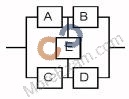
Question58: Data collection for a failure reporting, analysis, and corrective action system is important. The control of input data is BEST determined by:
Response:

Question59: Human factors in product safety planning are assessed for which of the following reasons?
I. To allocate the proper balance between man and machine.
II. To address the limitations of human beings.
III. To determine the user hardware interaction.
Response:

Question60: What is the reliability of this system?
Where component reliabilities, A = 0.80 B = 0.95 C = 0.82 D = 0.85 E = 0.75

Response:

Question61: As the reliability engineer overseeing supplier development, you review the supplier's corrective action problem solving guidebook. It is a structured approach and you notice in the problem definition segment that there is a reference to "is data" and "is not data".
You recognize that they are using a technique promoted and championed by:
Response:

Question62: In the binomial expression:
Response:

Question63: A field test may be considered satisfactory if:
Response:

Question64: For complex electronics systems, the major contributor to repair time is generally:
Response:

Question65: Specifically, up-time ratio is a measure of:
Response:

Question66: Failure modes and effects analysis involves what activity?
Response:

Question67: What is the general use of an R chart?
Response:

Question68: A reliability test of 12 pumps is terminated at 1000 hours. There were 5 failures as follows, what is the median rank % for the 4th failure ?

Response:

Question69: The reliability growth factor is MOST important to consider in which of the following situation?

Response:

Question70: As the reliability engineer of a medium sized firm, you have developed a reliability test plan for the shop.
The shop manufactures products on a medium batch size basis. The batches range from 30 to 500 pieces per order. The test plan should include all of the following consideration EXCEPT Response:

Question71: The failure rate for an IC chip is 0.0023 per hour of operation. Calculate the MTBF given that the failure rate is constant.
Response:

Question72: The techniques of design control are:
Response:

Question73: Failure data are analyzed and a proportion of items survive to the end of the test. Data on these types of samples are referred as:
Response:

Question74: A qualification test is used to determine that design and selected production methods will yield a product that conforms to specification.
An acceptance test is used to determine that a completed product conforms to design. On this basis, a destructive test can be used for:
Response:

Question75: Given mean-time-to-failure of 200 hours for each of two components, what is the probability of system failure if both components operate in parallel for one hour?
Response:

Question76: Which of the following BEST describe a critical item in reliability?
Response:

Question77: According to Taguchi, robustly designed experiments should employ all of the following techniques EXCEPT Response:

Question78: Which of the following is an analytical approach used during the manufacturing process where process conditions are changed systematically for the purpose of determining modifications required for product improvement?
Response:

Question79: Weibull analysis is a way to quickly and easily analyze field data or interval test data. The limits of the use of this technique include having a good estimate for the:
Response:

Question80: A resistor is rated at 1 watt. One example of using this resistor in a derated condition is using:
Response:

Question81: A full factorial design of experiments has four factors. The first factor has two levels, the second factor has three levels, the third factor has two levels, and the final factor has four levels. How many runs are required for this analysis?
Response:

Question82: An undesired event in a system led to the below fault tree. Which of the following are the cut sets of the fault tree?

Response:

Question83: Which answer mathematically expresses the reliability of an active parallel system in which all component reliabilities are unequal?

Response:

Question84: All of the following statements concerning statistical inference are true EXCEPT:
Response:

Question85: It is of primary importance that the choice of the time-to-failure distribution to represent a particular reliability situation be based on:
Response:

Question86: In a certain application, two identical transducers are used to measure the vacuum in a system. The system is considered to have failed if either of the vacuums read by the transducers varies from the standard by more than 10mm Hg.
Which of the following is the correct reliability logic block diagram for the transducer assembly?

Response:

Question87: In which of the following distribution is the standard deviation equal to the mean?
Response:

Question88: Which of the following calculation is used to determine the overall tolerance for the serial combination of the component?
Response:

Question89: When parts are selected for a product in development, which of the following key elements should be considered first?
Response:

Question90: Product safety is a concern in today's environment. If a risk assessment is performed near the end of the design stage, consideration should be based on:
I. Hazard probability.
II. Hazard severity.
III. Risk impact.
IV. Cost impact.
Response:

Question91: It is often observed that unscheduled maintenance:
Response:

Question92: Maintenance times on simple with straightforward repair will fit which of the following distributions?
Response: